
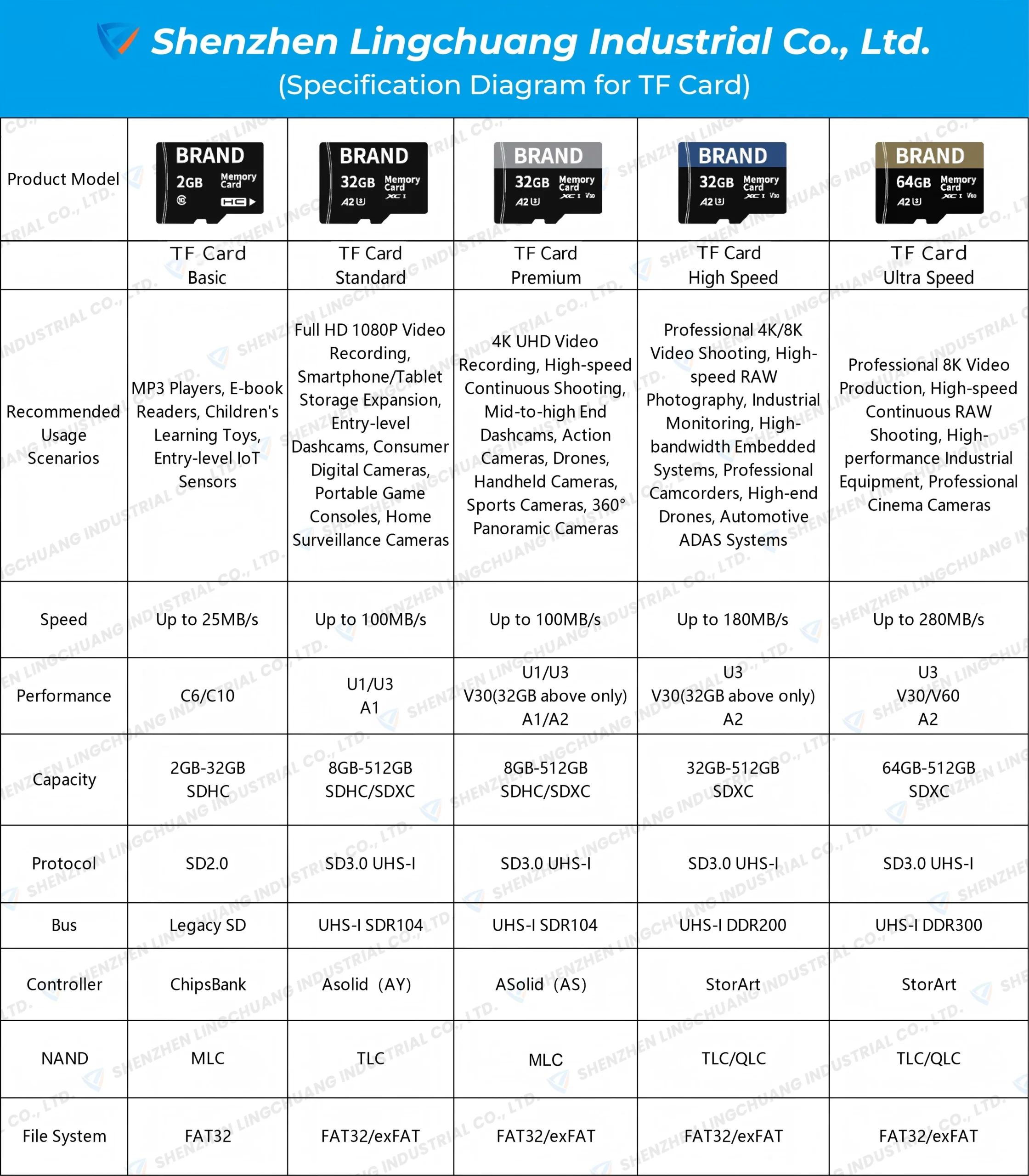
With the full popularization of smart devices, TF cards have become the core storage accessory for a full range of hardware, including children’s toys, smartphones,dashcams, action cameras, industrial monitoring, and professional photography equipment, thanks to their compact size and flexible expansion capabilities. However, when facing TF cards with different speed grades, performance specifications, and hardware configurations, many users and corporate customers often find it difficult to distinguish product differences and cannot accurately match their own usage needs.
Based on our full range of 5 gradient TF card products, this article comprehensively breaks down the core differences of different series of TF cards from four core dimensions: positioning scenarios, core performance, hardware configuration, and capacity specifi cations, to provide professional and clear reference for individual purchase and corporate customization.
The core difference between different series of TF cards starts with accurate scenario positioning. From entry-level basic models to flagship ultra-high-speed models, each product corresponds to clear usage needs. There is no absolute advantage or disadvantage, only whether it adapts to the scenario.
1.TF Card Basic(SD 2.0)
As an entry-level basic storage solution, the Basic TF card focuses on ultimate compatibility and high cost-effectiveness, designed for low-power and lightweight storage scenarios.
Recommended Scenarios: MP3 players, e-book readers, children’s learning toys, entry-level IoT sensors, simple file storage, and other scenarios that have no high requirements for speed and only need basic and stable storage. With Legacy SD bus and SD2.0 protocol, it can be perfectly compatible with various legacy devices and low-power embedded hardware, with almost no identification and compatibility problems.
2.TF Card Standard(SD 3.0)
The Standard model is the mainstream cost-effective choice in the consumer market, positioned as entry-level HD storage to meet the core storage needs of daily consumer devices.
Recommended Scenarios: Storage expansion for smartphones and tablets, Full HD 1080P video recording, household dashcams, consumer digital cameras, portable game consoles, home surveillance cameras, etc. It supports U1/U3 speed grade and A1 application performance, which can not only smoothly store HD videos, but also meet the installation and operation needs of mobile phone apps, making it an all-round basic model for household and daily consumer scenarios.
3. TF Card Premium(SD 3.0-pro)
The Premium model is a mid-to-high-end product focusing on high durability. Its core highlight is the use of MLC NAND flash, which has a longer program/erase cycle life and more stable high and low temperature performance than ordinary TLC flash, designed for high-load and long-term operation scenarios.
Recommended Scenarios: 4K UHD video recording, high-speed continuous shooting, mid-to-high end dashcams, action cameras, drones, handheld cameras, 360° panoramic cameras, etc. It supports U1/U3 speed grade, V30 video speed grade (for 32GB and above capacity), and A1/A2 application performance. It can not only meet the stable continuous recording of 4K videos, but also be competent for loop recording monitoring and dashcam scenarios with the high durability of MLC flash, making it a high-reliability choice for consumer and light industrial scenarios.
4. TF Card High Speed(SD 3.0-DDR200)
The High Speed model is a professional high-speed storage solution, positioned for high-performance professional scenarios, focusing on ultimate continuous read and write speed and professional video recording capabilities.
Recommended Scenarios: Professional 4K/8K video shooting, high-speed RAW format continuous shooting, industrial monitoring, high-bandwidth embedded systems, professional camcorders, high-end drones, automotive ADAS systems, etc. It has a maximum read speed of 180MB/s, supports U3 speed grade, V30 video speed grade and A2 application performance grade. Compared with A1 specification, A2 grade has stronger random read and write performance, can run large applications and programs more smoothly, and is perfectly suitable for professional photography and industrial high-load scenarios.
5. TF Card Ultra Speed(SD 3.0-DDR200)
The Ultra Speed model is our flagship storage product, positioned for professional extreme performance scenarios, and is the model with the highest speed limit and strongest performance specifications in the full series.
Recommended Scenarios: Professional 8K video production, high-speed continuous RAW format shooting, high-performance industrial equipment, professional cinema cameras, and other scenarios with extreme requirements for speed, stability and durability. It has a maximum read speed of 280MB/s, supports U3 speed grade, V30/V60 video speed grade and A2 application performance. It can easily handle real-time recording of 8K RAW videos, while maintaining stable operation in wide temperature environments and high-load industrial scenarios, making it the flagship choice for professional and industrial scenarios.
In addition to the superficial scenario positioning, the parameter and hardware differences of different series of TF cards directly determine the upper speed limit, service life and operation stability of the product, and are also the core reference indicators for enterprise customization and selection.
1.Differences in Read/Write Speed and Performance Grade
Speed is the most intuitive difference between different series of TF cards, which directly determines the upper limit of the applicable scenarios of the product. The core parameter comparison is as follows:
| Product Series | Max Read Speed | Core Performance Grade | Core Adaptability |
| Basic | 25MB/s | C6/C10 | Basic file storage, lightweight device adaptation |
| Standard | 100MB/s | U1/U3, A1 | 1080P video recording, mobile APP operation |
| Premium | 100MB/s | U1/U3, V30, A1/A2 | 4K video recording, high-load loop recording |
| High Speed | 180MB/s | U3, V30, A2 | 4K/8K high-speed shooting, professional device adaptation |
| Ultra Speed | 280MB/s | U3, V30/V60, A2 | 8K professional video recording, industrial high-load |
We also give a popular interpretation of the core performance identifiers to help quickly understand the parameters:
· Class (C Grade): Basic speed grade, C6/C10 means the minimum sustained write speed is not less than 6MB/s and 10MB/s, which is the core standard for entry-level storage.
· UHS Speed Class (U Grade): U1/U3 means the minimum sustained write speed is not less than 10MB/s and 30MB/s, which is the basic threshold for HD video recording.
· Video Speed Class (V Grade): V30/V60 means the minimum sustained write speed is not less than 30MB/s and 60MB/s. V30 is the minimum requirement for 4K video recording, and V60 can stably handle 8K video recording.
· Application Performance Class (A Grade): A1/A2 represents random read and write performance. A2 grade far exceeds A1 in random read and write and IOPS performance, and can run APPs and programs installed on the TF card more smoothly.
2.Differences in Core Hardware Configuration (Determine Service Life and Stability)
Hardware configuration is the core competitiveness of TF cards, and also the essential difference between different series of products:
Controller: The Basic model adopts an entry-level controller, focusing on ultimate compatibility and low power consumption; the Standard and Premium models adopt mainstream controllers, among which the Premium solution is specially optimized for high-load scenarios and is more stable with MLC flash; the High Speed and Ultra Speed models adopt high-performance controllers, specially optimized for high-speed UHS-I bus, to fully release the flagship speed potential.
NAND Flash: The Basic and Premium models adopt MLC flash, which has longer program/erase cycle life and better high and low temperature stability, and is more suitable for industrial and high-load loop writing scenarios; the Standard model adopts TLC flash, which balances cost-effectiveness and service life, and is the optimal solution for consumer scenarios; the High Speed and Ultra Speed models adopt TLC/QLC flash, which achieves high cost-effectiveness of large capacity while ensuring high-speed performance.
Bus and Protocol: The Basic model adopts SD2.0 protocol and Legacy SD bus, with full compatibility; the other 4 series all adopt SD3.0 UHS-I protocol, and the bus specification is upgraded step by step from SDR104 to DDR300, which directly brings a leap-forward increase in read speed from 100MB/s to 280MB/s.
The capacity coverage of different series accurately matches the storage needs of the corresponding scenarios: the Basic model covers 2GB-32GB SDHC specification, focusing on small-capacity customization; the Standard and Premium models cover 8GB-512GB SDHC/SDXC specification, with the widest adaptation range; the High Speed model starts from 32GB, and the Ultra Speed model starts from 64GB, focusing on large-capacity professional storage.
All series of products support FAT32/exFAT file system, with excellent device compatibility, and can be plug-and-play whether it is Windows, Mac system, Android, or embedded devices.
3. Full-Scene Selection and Customization Guide
Faced with 5 TF cards with different positioning, there is no need to blindly pursue the highest specifications. The core is to match your own usage scenarios and cost requirements. We give the following accurate selection suggestions:
①Lightweight basic storage scenarios: children’s toys, IoT sensors, MP3 players, small-capacity file storage, give priority to the Basic model, with ultimate compatibility and low procurement cost, which is the optimal solution for mass customization.
②Household consumer daily scenarios: mobile phone expansion, household dashcams, home monitoring, 1080P video recording, give priority to the Standard model, with balanced performance and extremely high cost-effectiveness, to meet most daily needs.
③High-load durability scenarios: long-term loop recording dashcams, action cameras, drones, mid-range 4K shooting, give priority to the Premium model. The high durability brought by MLC flash greatly improves the service life in high-load scenarios.
④Professional high-speed shooting scenarios: professional 4K/8K photography, high-speed continuous shooting, high-end drones, industrial monitoring, give priority to the High Speed model, with 180MB/s read speed and A2 grade performance, which is perfectly suitable for the high-speed storage needs of professional equipment.
⑤Flagship professional industrial scenarios: 8K professional film and television production, high-performance industrial equipment, high-load operation in wide temperature environments, give priority to the Ultra Speed model, with 280MB/s flagship speed and V60 video grade, competent for all professional storage scenarios.
As a professional OEM&ODM manufacturer of storage products, we can provide full-process customization services for the full range of TF cards, covering the full capacity range from 1GB to 1TB, supporting personalized services such as appearance silk screen printing, brand customization, performance parameter adjustment, firmware optimization, and pre-installed files. Whether it is consumer gift customization or industrial high-reliability storage product development, we can provide you with a stable, reliable and cost-effective one-stop solution.
With the continuous upgrading of smart devices, the performance requirements for TF cards are also continuously improving, but the demand for storage products in different scenarios is always differentiated. From entry-level basic models to flagship ultra-high-speed models, choosing the product that suits your own scenario can maximize the value of the storage device while controlling costs.