
2026年11月22日
U 盘预装内容与自定义 VID/PID:规格该怎么写
展会与礼品用盘常在两处翻车:盘里是旧版内容,或客户机器认不出设备。本文把预装内容与设备标识拆成两条独立验收线,讲清母版归属、哈希清单、分区与只读、授权合规、抽样验收、VID/PID 改动后果与复单一致性,并给出可抄进 PO 的表述。

本文提供英文版本。
Two weeks before a trade show, the cartons arrive with last season's demo reel on every drive. Or the content is right, and a customer plugs a drive in and the machine lists an unknown device.
Preloaded content and device identity are two separate acceptance lines, each needing its own owner, its own check, and its own record. Teams that merge them usually meet the difference at the worst moment.
Two Failures, Two Acceptance Lines
A content failure ships to everyone at once, and it is visible the moment someone opens the drive. Stale files or a draft video in the final slot produce it quickly.
An identity failure is quieter and lasts longer, because the drive mounts while the system reports a name nobody recognizes. Support tickets then arrive weeks later, and the risk lands on whoever answers them.
Six Items the Content Specification Must Carry
Many purchase orders, or POs, say preload the attached files and stop there. That sentence hands the version, the method, and the acceptance test to the supplier, so six items close the gap.
- Content version: a release name plus a hash value for every file, so both sides confirm the same bytes arrived.
- Master source: whether your team sends the master or the supplier assembles it, and who approves the final set.
- Layout: the writing tool class, the number of partitions, and what sits in each one.
- Protection mode: which parts a user may change and which must survive a full format.
- Rights: written confirmation that every file may be redistributed, including fonts, footage, and trial installers.
- Sampling: how many units are opened and checked, and what result counts as a pass.
Write Protection, Layout, and the Payload Itself
Read-Only Is a Setting, Not a Guarantee
Read-only behaviour can be set at the controller level, or written as a flag a formatting tool may clear. Ask which applies to your order, then confirm it on a sample before approval.
A small installer partition with the rest left writable is a common pattern for software distribution. That layout also changes how the host sees the drive, so write it into the specification.
Rights and Licensing Travel With the Files
The supplier writes what you send, which does not make the payload yours to distribute. Fonts, footage, music, and trial installers carry their own terms, so ask for written confirmation that the master set is cleared, and keep it with the version record.
Sampling: Proving the Run Actually Loaded
One verified sample proves the master works, not that the run is correct. Agree a sampling plan before production, and make the check repeatable by anyone holding the hash list.
Useful checks are quick and binary. Open a drive, compare the file list with the master, hash a few files, and play the first and last item a user would touch. Record which units were checked, by carton.
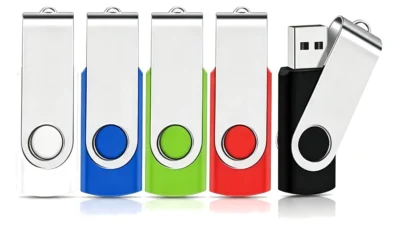
Body type changes one habit rather than the rule. On a rotating-body drive such as FD1003 or a labelled drive such as FD1006, confirm that the shell marking and the loaded release match. A correct image on a mislabelled body is still a shipping error, and the same rule holds for FD2005.
What a Custom VID and PID Actually Change
How a Host Recognizes a Drive
A USB (Universal Serial Bus) device introduces itself with a vendor identifier and a product identifier. The vendor identifier, or VID, names the maker, while the product identifier, or PID, names the model within that maker. That pair decides which driver loads and which name the system displays.
Changing the pair is a firmware-level step done with a production tool, not the same thing as printing a logo on the shell. After the change, the drive may appear under a new name, may need a matching driver, and may lose familiar recognition.
Some buyers want a custom pair so their software can detect the drive, or so the brand appears in the system list. Either aim needs a fallback for machines that reject the change.
Risk Boundaries for Identity Changes
A custom identifier is not a certificate, and it makes a drive compliant with nothing on its own. It also does not decide which systems will accept the device.
Ask the supplier to confirm three things in writing: the tool that writes the identifier, whether the change can be reversed, and the behaviour without a matching driver. A drive that fails to mount on one platform is a support problem, not a design feature.
Record the original identifier of the base model before any change, because that record is the only reliable way back if a later order must revert.
Repeat Orders: Keeping Both Lines Stable
Repeat orders fail for dull reasons: the master was overwritten, the hash list was never archived, or someone rebuilt the image from memory. None of it shows until the second run ships.
Four habits prevent it: archive the master with its hash list and date, and never reuse a release name. Require written notice before any change, and keep a sealed sample from every run.
What to Put in the Purchase Order
| Specification item | If it is left unwritten | Wording to use |
|---|---|---|
| Content version | Runs drift apart and nobody can prove which one shipped. | "Release named, hash list attached as an annex." |
| Layout | The installer partition vanishes after a user format. | "Installer partition read-only; remaining space writable." |
| Protection mode | Users delete the payload by accident. | "Protection set at controller level and confirmed on samples." |
| Rights | A rights claim arrives after the campaign has run. | "Buyer confirms clearance; supplier files the confirmation." |
| Sampling | A whole run ships without a single check. | "Sample size and pass criteria fixed before the run." |
| VID and PID | The device shows as unknown on some machines. | "Custom pair recorded, with the original documented for revert." |
| Change notice | A silent swap reaches the second order. | "Written notice before any change to content or identifier." |
Start With the Two Lists
Write the content list and the identity list separately, then attach both to the order. A supplier who answers only one has answered half the brief.
Shenzhen LingC Industrial Co., Ltd. supplies card readers, internal SSD, memory cards, portable SSD, USB flash drives, and USB hubs & docks. Send both lists to Cherie at Cherie@lingctech.com, and we will confirm what can be documented for your order.
本文亦发布于 lingctech.com 博客。查看线上原文

正在采购本文中提到的产品?
发送你需要的型号与数量,1-2 个工作日内回复报价、交期与打样方案。