
23. Oktober 2026
Wie Sie einen Speicherhersteller vor der Bestellung prüfen: Prüffliste für Einkäufer
Eine praktische Checkliste für Speicher-Einkäufer: was vor einem Besuch aus der Ferne zu prüfen ist, was vor Ort inspiziert werden sollte, welche Aufzeichnungen ein echter Hersteller führt und welche Warnzeichen auf eine Handelsgesellschaft statt einen Hersteller hindeuten.
Dieser Beitrag ist auf Englisch verfügbar.
Storage buyers rarely get burned on price. They get burned on identity: a supplier that presents itself as a factory, quotes factory pricing, and turns out to be a trading company with no line, no test equipment and no quality records. The verification below separates the two before an order is placed, not after a failed delivery.
None of this requires a suspicion of bad faith. Most trading companies are legitimate businesses that simply cannot offer what a manufacturer offers — process control, rework capability, or traceability. Knowing which one you are dealing with tells you what the relationship can and cannot deliver.
Step 1: verify remotely, before anyone visits
- Business licence: check the registered entity name, legal representative and registered capital. The name on the licence must match the name on the quotation, the contract and the invoice.
- Certification scope: a certificate states what is certified, not just that it exists. Ask for the certificate and read the scope line — for a quality management system it should cover the products being quoted, and the certificate should be within its validity period.
- Address consistency: the licence address, the certificate address and the factory address you are invited to should be the same site. Different addresses are the single strongest signal of a trading layer.
- Capacity claims: ask what monthly output a claimed line produces, then ask how many lines of that type exist. A claim that cannot survive arithmetic is a claim, not a capacity.
- Product evidence: ask for photographs of the specific models being quoted, on the production line, with the order of work visible. A library of catalogue images is not evidence of production.
Step 2: what to inspect on site
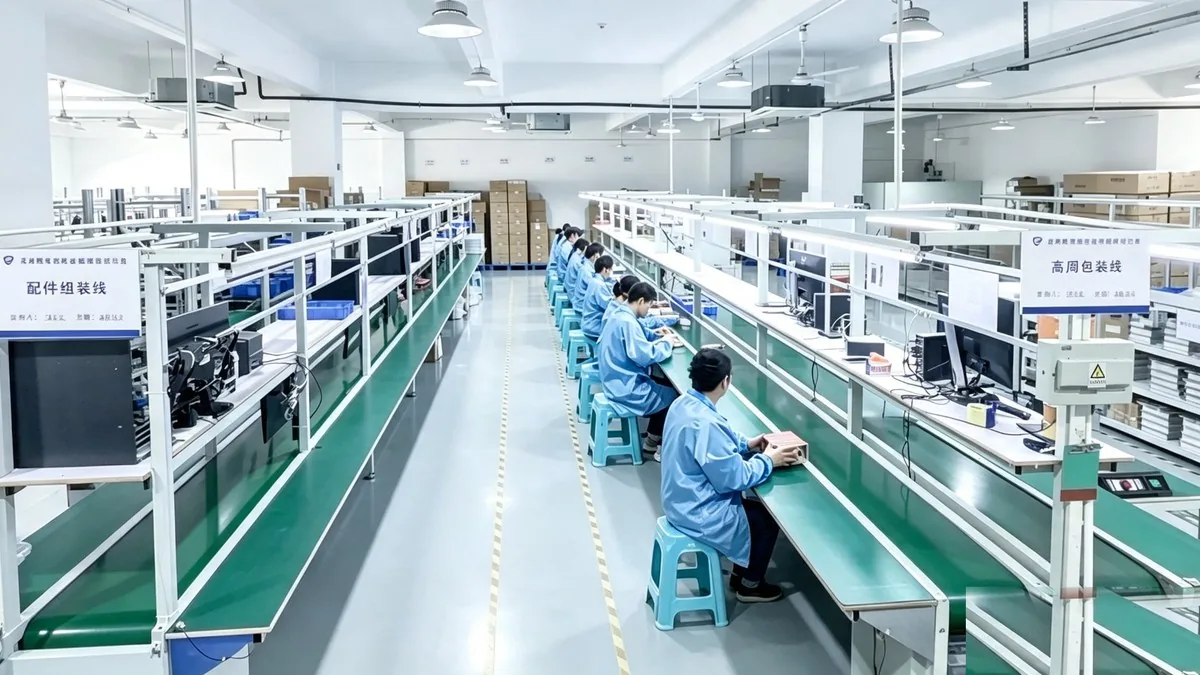
A working storage factory does not need to look modern. It needs to show that materials move through controlled steps and that each step leaves a record. Walk the flow in the order a product travels — incoming, assembly, test, packaging — rather than in the order the host prefers.
| Area | What a real line shows | What to ask for |
|---|---|---|
| Incoming material | Barcoded reels or trays with supplier and date codes, segregated quarantine area | A recent incoming inspection record for one lot |
| Assembly / production | Work instructions posted at the station, ESD controls, operators following the same sequence | The work instruction for the model being quoted |
| Testing | Dedicated test equipment — copiers, low-level format stations, temperature chambers, burn-in racks — running during the visit | A test log from the same week, not a sample report |
| Packaging | Artwork approval sheet taped at the packing station, matching the approved proof | The artwork approval record for a recent order |
| Records | Traceability from a finished unit back to its component lot and operator | One random finished unit traced back on the spot |
Step 3: the records a manufacturer keeps and a trader does not
Records are the fastest way to tell the two apart, because a trader cannot manufacture them. A trading company can forward a test report it bought; it cannot show you the shift log that produced it, the rework ticket for a failed batch, or the calibration sticker on the chamber that ran the test.
- Incoming inspection records for component lots — the single best evidence that quality starts at the receiving dock.
- In-process and final test logs, kept per batch rather than per sample.
- Equipment calibration records for test instruments — an uncalibrated chamber invalidates every report it produced.
- Rework and scrap tickets, with the disposition of the affected units.
- Customer complaint records and the corrective actions taken — a factory with no complaints has either no history or no records.
If a visit is not possible
A live video walk-through is a reasonable substitute for a first order, provided it is genuinely live: ask the host to pan to the clock, to show the work order currently on the line, and to run one unit through the test station while you watch. A third-party audit report from a recognised inspection body is stronger still, and is what many overseas buyers commission before their first order.
Warning signs worth a second conversation
- Reluctance to name the actual production site, or an invitation to an office rather than a plant.
- Quotation turnaround faster than a factory could schedule, with no lead-time qualification.
- Certificates offered as images without scope, issuing body or validity period.
- Every question about process answered by a question about price.
- Refusal of a third-party inspection at shipment, when the order size justifies one.
What verification buys you
A verified factory changes the terms of the whole relationship: rework becomes possible instead of a dispute, a batch issue becomes a traceable event instead of a guess, and a second order becomes a scheduling conversation instead of a new negotiation. That is why the buyers who run this checklist once tend to keep the same manufacturer for years.
Dieser Beitrag ist auch im lingctech.com-Blog veröffentlicht.Originalbeitrag ansehen
Sie beschaffen die Produkte aus diesem Beitrag?
Senden Sie Modelle und Mengen — Preis, Lieferzeit und Muster in 1-2 Werktagen.