
2026年10月23日
発注前にストレージ工場を確認する方法:購買担当者の監査チェックリスト
ストレージ購買担当者向けの実用的なチェックリストです。訪問前に遠隔で確認すべき事項、現地で検査すべきポイント、本物の工場が保管している記録、そして供給側がメーカーではなく貿易会社であることを示す警告サインをまとめました。
この記事は英語でご覧いただけます。
Storage buyers rarely get burned on price. They get burned on identity: a supplier that presents itself as a factory, quotes factory pricing, and turns out to be a trading company with no line, no test equipment and no quality records. The verification below separates the two before an order is placed, not after a failed delivery.
None of this requires a suspicion of bad faith. Most trading companies are legitimate businesses that simply cannot offer what a manufacturer offers — process control, rework capability, or traceability. Knowing which one you are dealing with tells you what the relationship can and cannot deliver.
Step 1: verify remotely, before anyone visits
- Business licence: check the registered entity name, legal representative and registered capital. The name on the licence must match the name on the quotation, the contract and the invoice.
- Certification scope: a certificate states what is certified, not just that it exists. Ask for the certificate and read the scope line — for a quality management system it should cover the products being quoted, and the certificate should be within its validity period.
- Address consistency: the licence address, the certificate address and the factory address you are invited to should be the same site. Different addresses are the single strongest signal of a trading layer.
- Capacity claims: ask what monthly output a claimed line produces, then ask how many lines of that type exist. A claim that cannot survive arithmetic is a claim, not a capacity.
- Product evidence: ask for photographs of the specific models being quoted, on the production line, with the order of work visible. A library of catalogue images is not evidence of production.
Step 2: what to inspect on site
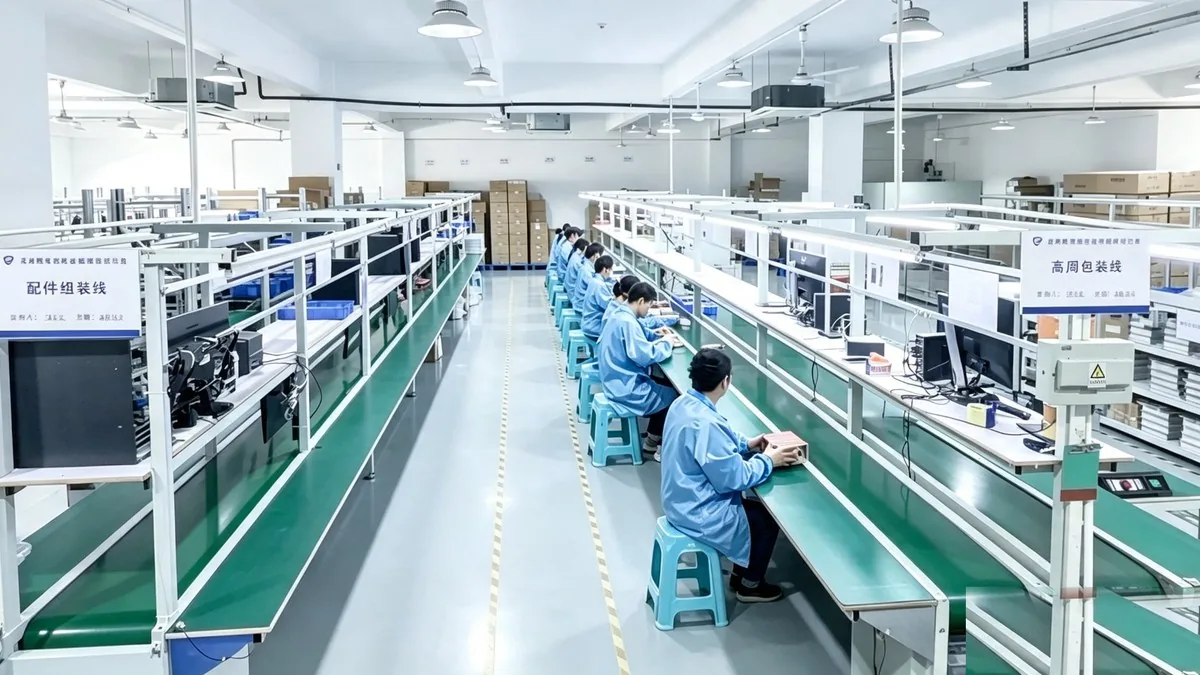
A working storage factory does not need to look modern. It needs to show that materials move through controlled steps and that each step leaves a record. Walk the flow in the order a product travels — incoming, assembly, test, packaging — rather than in the order the host prefers.
| Area | What a real line shows | What to ask for |
|---|---|---|
| Incoming material | Barcoded reels or trays with supplier and date codes, segregated quarantine area | A recent incoming inspection record for one lot |
| Assembly / production | Work instructions posted at the station, ESD controls, operators following the same sequence | The work instruction for the model being quoted |
| Testing | Dedicated test equipment — copiers, low-level format stations, temperature chambers, burn-in racks — running during the visit | A test log from the same week, not a sample report |
| Packaging | Artwork approval sheet taped at the packing station, matching the approved proof | The artwork approval record for a recent order |
| Records | Traceability from a finished unit back to its component lot and operator | One random finished unit traced back on the spot |
Step 3: the records a manufacturer keeps and a trader does not
Records are the fastest way to tell the two apart, because a trader cannot manufacture them. A trading company can forward a test report it bought; it cannot show you the shift log that produced it, the rework ticket for a failed batch, or the calibration sticker on the chamber that ran the test.
- Incoming inspection records for component lots — the single best evidence that quality starts at the receiving dock.
- In-process and final test logs, kept per batch rather than per sample.
- Equipment calibration records for test instruments — an uncalibrated chamber invalidates every report it produced.
- Rework and scrap tickets, with the disposition of the affected units.
- Customer complaint records and the corrective actions taken — a factory with no complaints has either no history or no records.
If a visit is not possible
A live video walk-through is a reasonable substitute for a first order, provided it is genuinely live: ask the host to pan to the clock, to show the work order currently on the line, and to run one unit through the test station while you watch. A third-party audit report from a recognised inspection body is stronger still, and is what many overseas buyers commission before their first order.
Warning signs worth a second conversation
- Reluctance to name the actual production site, or an invitation to an office rather than a plant.
- Quotation turnaround faster than a factory could schedule, with no lead-time qualification.
- Certificates offered as images without scope, issuing body or validity period.
- Every question about process answered by a question about price.
- Refusal of a third-party inspection at shipment, when the order size justifies one.
What verification buys you
A verified factory changes the terms of the whole relationship: rework becomes possible instead of a dispute, a batch issue becomes a traceable event instead of a guess, and a second order becomes a scheduling conversation instead of a new negotiation. That is why the buyers who run this checklist once tend to keep the same manufacturer for years.
この記事も lingctech.com のブログに公開しています。元記事を見る