
November 12, 2026
Export Transit Validation: Qualifying Packaging for Drop, Vibration and Compression
Why a box qualified for a shelf fails as a shipper, how to sequence conditioning, drop, vibration and compression tests, and what to write into a packaging specification and a claim file.
Cet article est disponible en anglais.
Most storage accessory damage found at an overseas warehouse is not a manufacturing defect. It is a packaging decision taken months earlier: a box qualified for a shelf and reused as a shipper, or an insert changed without a drop repeated.
Shelf Packaging and Transit Packaging Are Not the Same Specification
Retail packaging is judged by a shopper in three seconds: print fidelity, shelf presence, hang tab, planogram fit. Its failures are commercial — scuffed print, a crushed corner.
Transit packaging is judged by a receiver with a scanner: closed, square, labeled, right count, units electrically intact. Its failures are functional — cracked housings, torn strain relief, dislodged connectors, moisture staining.
The two meet in the retail-ready shipper, where a printed box is also the shipping unit. That is legitimate, but validate it as one system: a frequent failure mode is a box qualified for pallet compression and then shipped as a loose parcel.
Sequencing the Test Programme
Order matters as much as the tests: conditioning, drop, vibration, compression, with altitude or climate cycling where the route requires it.
- Conditioning — defined temperature and humidity first (ASTM D4332); a carton qualified dry and shipped through a humid port is unqualified.
- Drop — free fall on corners, edges and faces (ASTM D5276). Corner drops reveal most: energy concentrates on one point, and the insert either holds the unit or lets it shift.
- Random vibration — (ASTM D999) the grind of road and rail; it propagates hairline cracks a drop has started and exposes unit-to-unit abrasion.
- Compression — (ASTM D642) the stacking test, placed last because it represents the bottom carton after everything else.
- Altitude and climate — low pressure (ASTM D6653) for air freight, where sealed bags expand; humidity conditioning for sea freight.
ASTM D4169 sets assurance levels and sequences by mode; the ISTA 1 series screens a design, the 3 series runs a full conditioned parcel sequence. Screen early, validate before committing a lot.
Sample cartons from more than one lot, and insist the report states sequence, conditioning, sample size and pass or fail criteria. A pass without criteria is not a result.
Shipper, Insert, Divider, Cushioning and Void Fill
Shipper. Grade, flute and basis weight decide compression strength more than print does. Double wall belongs where cartons stack high; internal dimensions follow the insert, not a guess.
Insert. A pulp, EVA or PET tray fixes orientation, which makes a drop test repeatable. A shallow tray lets the unit ride up and take impact on its face.
Divider. Partitions stop unit-to-unit abrasion and secondary impact; on printed ABS shells, abrasion is often the largest defect category.
Cushioning. Only where the unit can move inside the carton; foam everywhere raises cube and freight cost without improving the drop result.
Void fill. Loose fill is the last resort: it settles in transit, so hour-one protection is not hour-forty protection.
Two Weight Classes, Two Sets of Failure Modes
Mass and geometry decide which failure mode dominates. These three sit at opposite ends.
| Model | Form factor | Mass and size | Dominant transit failure | Packaging emphasis |
|---|---|---|---|---|
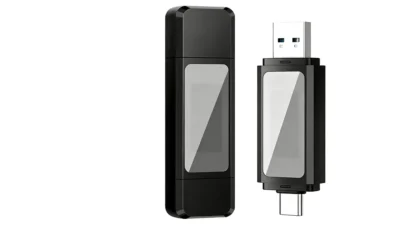
| FD2027 | Dual-head advertising USB drive, ABS, TFT display | 6 g, 37×18×18mm | Face impact, pilferage, short count | Rigid tray pocket, sealed bag |
| RD3001 | Single-slot card reader, ABS | 5.2 g, 43.5×20×10mm | Connector edge damage, unit lost in fill | Pocket retention, no loose fill |
| HB2090 | Five-port hub, ABS, 120 cm cable | 58.2 g, 104×30×10mm | Coil used as a lever, strain relief tear | Deep cradle, restrained coil |
The light devices are a count problem. At 6 g and 5.2 g, a unit that escapes its pocket is invisible in loose fill, and the count fails first. The answer is a counted tray with a sealed bag per unit, not more foam.
The HB2090 is the opposite case. At 58.2 g with a 120 cm cable, the cable behaves as a lever: coiled loosely beside the body, it loads the strain relief on every drop. It needs a cradle holding the body, separate restraint for the coil, and compression strength, because hub cartons end up buried in a stack.
Markings, Barcodes, Packing List and Unboxing Order
Markings separate a claim you win from one you absorb. Put carton ID and batch code on two adjacent faces, so one stays readable after a corner is crushed, and keep barcodes clear of seams.
The packing list belongs inside the carton and in an external pouch, so the count can be verified unopened. The unboxing order belongs in the specification: six faces, seal, open, each layer, count, then inspect. A receiver who opens first and photographs later has destroyed the evidence.
Building the Evidence Chain for a Claim
Transit claims fail on documentation, not argument. One carton file needs:
- six arrival photographs, carton ID and carrier label legible in one frame;
- a continuous unboxing video with no cuts, starting before the seal is broken;
- carton ID, batch code, packing list and total carton count;
- the position of each damaged unit, layer by layer;
- retained sealed samples from the same lot, with carton and insert;
- the carrier delivery record and a filing date inside the claim window.
The position record is used most and skipped most: one corner points to handling, a whole top layer to stacking, units touching the coil to the insert.
What to Require from the Supplier
Three documents, made contractual rather than a favour:
- Packaging specification sheet — grade, flute, internal dimensions, insert material and thickness, units per carton, label standard, unboxing order.
- Test report — standard number, sequence, conditioning, sample size, lot, pass or fail criteria.
- Change notification — any change to corrugated supplier, insert tooling, carton dimension or unit count triggers re-validation.
Acceptance Checklist
| Item | What to verify | Reject if |
|---|---|---|
| Shipper grade and flute | Matches the specification sheet | Grade differs, no re-test |
| Internal dimensions | Insert fits with no free play | Unit moves noticeably |
| Insert retention | Unit stays seated through a manual corner drop | Unit lifts out of the pocket |
| Dividers | Present between all units | Units touch each other |
| Cable handling | Coil restrained apart from the body | Coil loose against the connector |
| Label and carton ID | Two adjacent faces, clear of seams | One label spans a flap seam |
| Packing list | Inside plus external pouch | Count cannot be checked unopened |
| Test report | Sequence, lot, sample size, criteria stated | Pass claimed with no criteria |
| Change record | Last packaging change dated and re-tested | Change shipped without re-validation |
Is an ISTA 1 series drop test enough for an export carton?
It is a screen: good for rejecting a design early, but no replacement for a conditioned parcel or LTL sequence. For a first lot, pair it with a 3 series or ASTM D4169 cycle.
Do we need low-pressure testing if we ship by sea?
Altitude testing addresses air freight, where trapped air expands and sealed bags can split. Sea freight is better represented by humidity conditioning and compression, because the load is stacking and moisture.
Shenzhen LingC Industrial Co., Ltd. works with OEM and ODM buyers on packaging specification, carton validation and receiving documentation for storage accessories, and can advise on formats for a given route. Contact Cherie at Cherie@lingctech.com with your destination, mode and carton configuration.
Cet article est également publié sur le blog lingctech.com.Voir l’article original
Modèles cités dans cet article
Clés USB
FD2027
Clé USB à écran TFT double connecteur
- Interface
- USB 3.0 + Type-C
- Capacité
- 32GB~512GB
- Vitesse
- —

Lecteurs de cartes
RD3001
Lecteur de cartes à grande vitesse DDR225
- Interface
- Host: Type-C Card slots: TF
- Capacité
- —
- Vitesse
- —

Hubs et docks USB
HB2090
Hub USB 3.0 5 ports avec alimentation DC
- Interface
- Input: USB 3.0 Output: 4×USB 3.0 + DC-C
- Capacité
- —
- Vitesse
- —
Vous achetez les produits de cet article ?
Envoyez modèles et quantités : prix, délai et échantillons sous 1-2 jours ouvrés.