
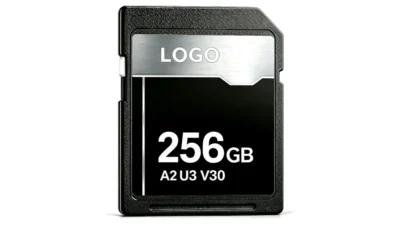
SDH3320
High-Speed SD Card
- Interface
- SD
- Capacity
- 64GB~512GB
- Speed
- Up to 180MB/s read
Mass production
For drone pilots, dash-cam users and camera teams who need cards that keep writing — TF and SD from SD 2.0 to DDR300 high speed, up to 512GB and 250MB/s read.
One-stop manufacturing
Product development, tooling, assembly, quality control and testing are handled in-house, with certified partners for PCBA / SMT. From sample to mass production under one roof.
Deep customization
Laser engraving, silk-screen and colour printing for your logo; enclosure material and PMS colour matching; retail packaging, capacity mix and firmware options.
Flexible MOQ & stable lead time
Standard order MOQ is 100 pcs per model for USB flash drives, memory cards, SSDs and portable SSDs, and 500 pcs for USB hubs, docks and card readers. Logo customization can start from 10 pcs. Typical lead time is 15–30 days depending on model, quantity and customization.
Certified quality control
Management systems: IATF 16949 (scope: design and production of mobile storage devices), ISO 9001, ISO 14001 and ISO 45001. These certify how the factory is managed, not individual products. CE / FCC / RoHS apply separately, on certified models across five product lines. Certificates and full test reports are available on request.
| Protocol | SD3.0 DDR200 / SD3.0 SDR104 / SD2.0 SDR50 |
|---|---|
| Capacity | 4GB–512GB |
| MOQ | 100 pcs |
| Lead time | 15 days |
| Warranty | 2 years |
7 models
SDH3320
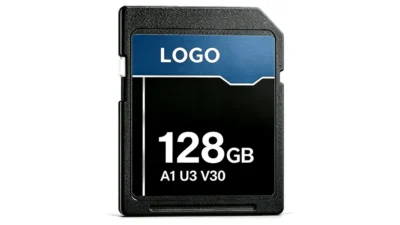
SDP3310
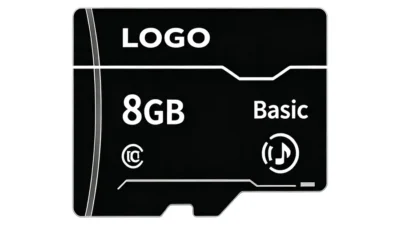
TFB0100

TFH3320

TFP3310

TFS3310
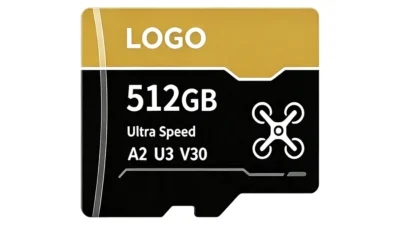
TFU3320
Choose by slot, not by capacity: TF (microSD) goes into action cameras, dash cams, phones and most embedded devices; full-size SD goes into cameras and recorders with a standard SD slot. LingC covers both — TF from 4GB to 512GB, SD from 32GB to 512GB. A TF card in an SD adapter works in most SD slots, but the adapter adds a contact point that can fail under vibration, so use native SD where the device accepts it.
Check three things in this order: sustained write speed under continuous recording (not peak read speed on the box), an endurance rating stated for rewrite-heavy workloads, and the operating temperature range for the enclosure it sits in. Dash cams and DVRs rewrite the same cells until they wear out, so a general-purpose card can fail within months regardless of capacity. Ask for all three in writing before ordering.
It is a unit convention, not a shortfall. Capacity is quoted in decimal GB (1GB = 1,000,000,000 bytes) while most operating systems report binary GiB (1GiB = 1,073,741,824 bytes), so the same physical capacity reads about 7% lower: 128GB shows as roughly 119GB, 512GB as roughly 476GB. Formatting overhead and any pre-loaded content explain the rest of the gap.
They describe the bus mode a card can negotiate, not a guaranteed transfer rate. DDR200 and DDR300 are high-speed interface modes; the number after "DDR" refers to the interface clock in MHz. Real throughput then depends on the host: TFU3320 is rated up to 250MB/s read in DDR300 mode, and TFH3320 / SDH3320 up to 180MB/s in DDR200, but both need a matching reader and large sequential files. In a lower-mode slot the card falls back automatically.
Work from the cheapest cause outward: confirm the card is fully seated and not write-locked; try another slot or reader, then another card in the same slot, to separate card from host; check the file system, because a card formatted by one device may be unreadable by another; test on a PC, where a card that mounts points to device-side compatibility rather than the card. Only then suspect the card itself.
Three things outrank capacity in an embedded design: the operating temperature range (a 0–70°C consumer card is a common failure point in cabinets and outdoor enclosures), behaviour during an unexpected power cut, since corruption usually happens mid-write, and write endurance under a fixed-capacity rewrite loop. Capacity is the easiest to buy and the least likely to be the real constraint.
By interface generation and capacity band. 入门 (Basic) is the SD2.0 SDR50 card for 4GB–32GB legacy and low-cost projects. 主力 (Standard) covers SD3.0 SDR104 in 32GB–256GB, the mainstream band, in both TF and SD form. 专业 (Professional) is the certified model of that same band. 高速 (High-Speed) moves to SD3.0 DDR200 with 64GB–512GB and up to 180MB/s read for high-bitrate recording. 极速 (Ultra) tops the line at DDR300, 250MB/s read, 64GB–512GB.
Usually a host limit, not a faulty card. Devices that only support SDHC accept up to 32GB; cards of 64GB and above are SDXC and also use exFAT, which older firmware often cannot read. The card is fine — the slot is the constraint. Our 入门 band stops at 32GB for exactly this case, while the other tiers start at 32GB and run to 512GB for devices rated for SDXC.
Other product lines
Send your target models and quantities. We reply with pricing, lead time and sample availability within 1–2 working days.